By Karis Cooper, DC | Clinically reviewed by Karis Cooper, DC
It’s 3 a.m. You’ve fed the baby, burped the baby, and lowered the baby into the bassinet without waking anyone. Then you stand up, and your lower back lets you know about it.
“It’s just part of having a baby.” Partly true. Back and pelvic pain after birth is common. That doesn’t mean you have to guess your way through it alone.
So here’s the real question: is what you’re feeling normal, or is it something to get checked? This post walks through what’s common with postpartum back pain, what isn’t, and who to call first.
The short answer: Postpartum back pain is common, and for many people it eases in the first few months after birth. For some, it lingers. A few symptoms aren’t back problems at all and need your OB, your midwife, or the emergency room first. Once those are ruled out, hands-on care has research behind it: in randomized trials, spinal manipulation and mobilization reduced postpartum back and pelvic pain in the short term. It works best as part of a plan that includes exercise and, when your symptoms point there, pelvic floor physical therapy.
Your body spent nine months adapting. It doesn’t reset overnight.
During pregnancy, your center of gravity moved forward, your lower back took on more load, and the ligaments around your pelvis loosened so it could open for birth. Those changes don’t reverse the day the baby arrives.
Then the new work starts. You lift a car seat over and over. You lean over a changing table, a bassinet, and a bathtub. You feed in the same rounded position several times a day, usually on very little sleep.
What’s common with postpartum back pain
These are the complaints we hear most from new parents:
- Low back ache that builds through the day, especially after lifting or bending.
- Pelvic girdle pain, felt at the back of the pelvis near the dimples, or at the pubic bone in front. It’s often worse on stairs, when you roll over in bed, or when you stand on one leg to get dressed.
- Upper back and neck tension from feeding and holding.
- Wrist and thumb pain from lifting and supporting the baby’s head, changing diapers, and lifting the baby in and out of the car seat.
Is diastasis recti linked to back pain?
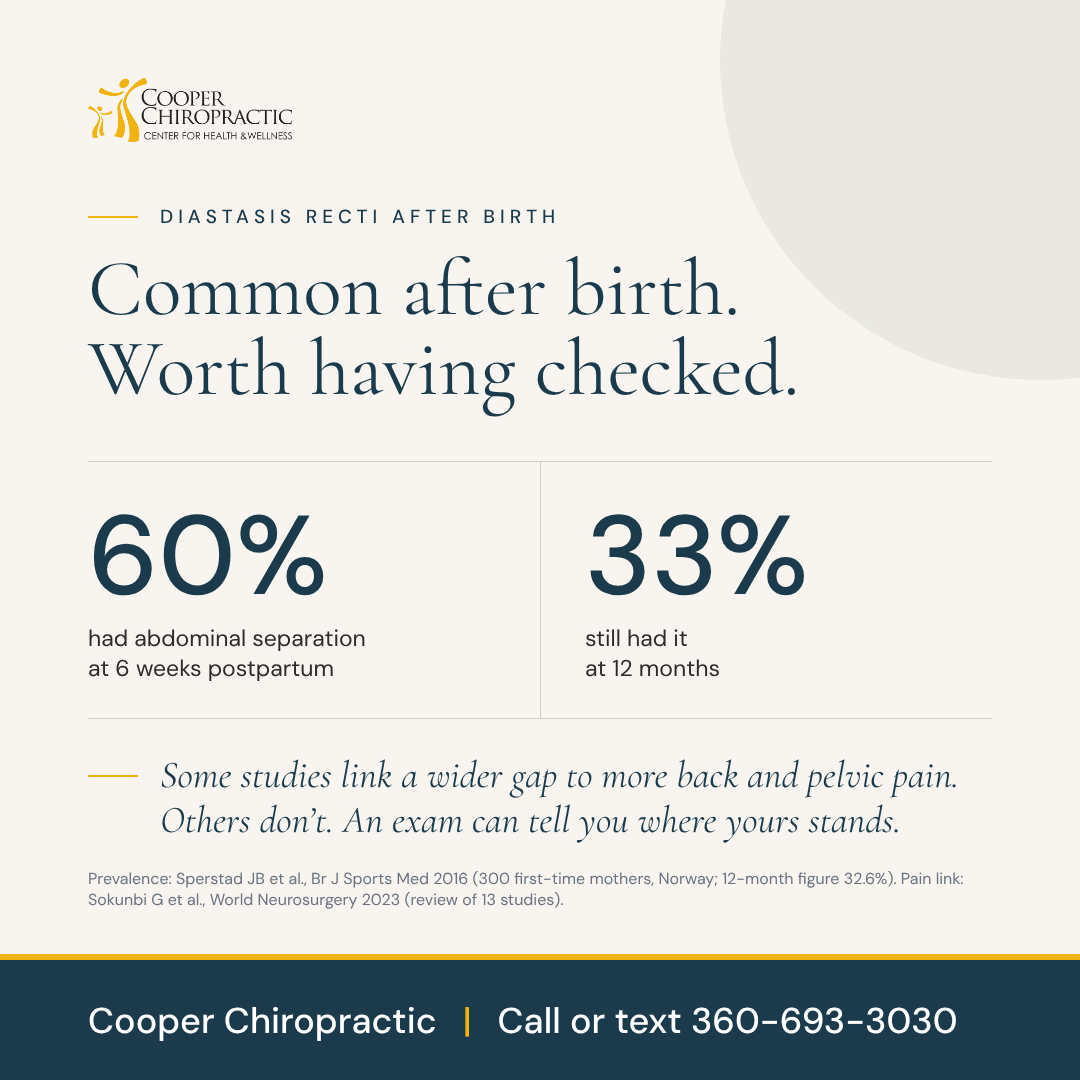
Sometimes, especially when the gap is wide. Diastasis recti is a separation of the abdominal muscles along the midline, and it’s very common after birth: in a study of 300 first-time mothers in Norway, 60% had it at 6 weeks postpartum and about a third still had it at 12 months.
Several studies have linked it to pain. Women with pelvic girdle pain in the first days after delivery had a wider gap when they did a curl-up than women without pain. In a study of 437 women measured 3 to 30 years after giving birth, gaps wider than 3 cm went with more severe low back pain in the women 3 to 10 years out.
The research isn’t unanimous, though. A 2023 review of 13 studies counted 5 that found a link to low back pain and 8 that didn’t, and the Norwegian study above found no difference in back and pelvic pain at 12 months. So a gap is worth having checked, especially a wide one or one that’s still there months later. It’s one of the things we look at, and it isn’t always the whole story.
What about my epidural?
Most epidurals go as planned. Occasionally, though, the needle punctures the thin membrane that holds the fluid around your spinal cord and nerves. That’s called an accidental dural puncture, and it can cause a severe headache that’s often worse when you sit up or stand.
That complication matters for your back, too. In a 2022 review of 12 studies, women who’d had an accidental dural puncture (or the headache that can follow one) were nearly three times as likely to report back pain lasting a year or more. If that happened during your delivery, tell your OB or midwife, and tell us.
What isn’t common, and who to call first
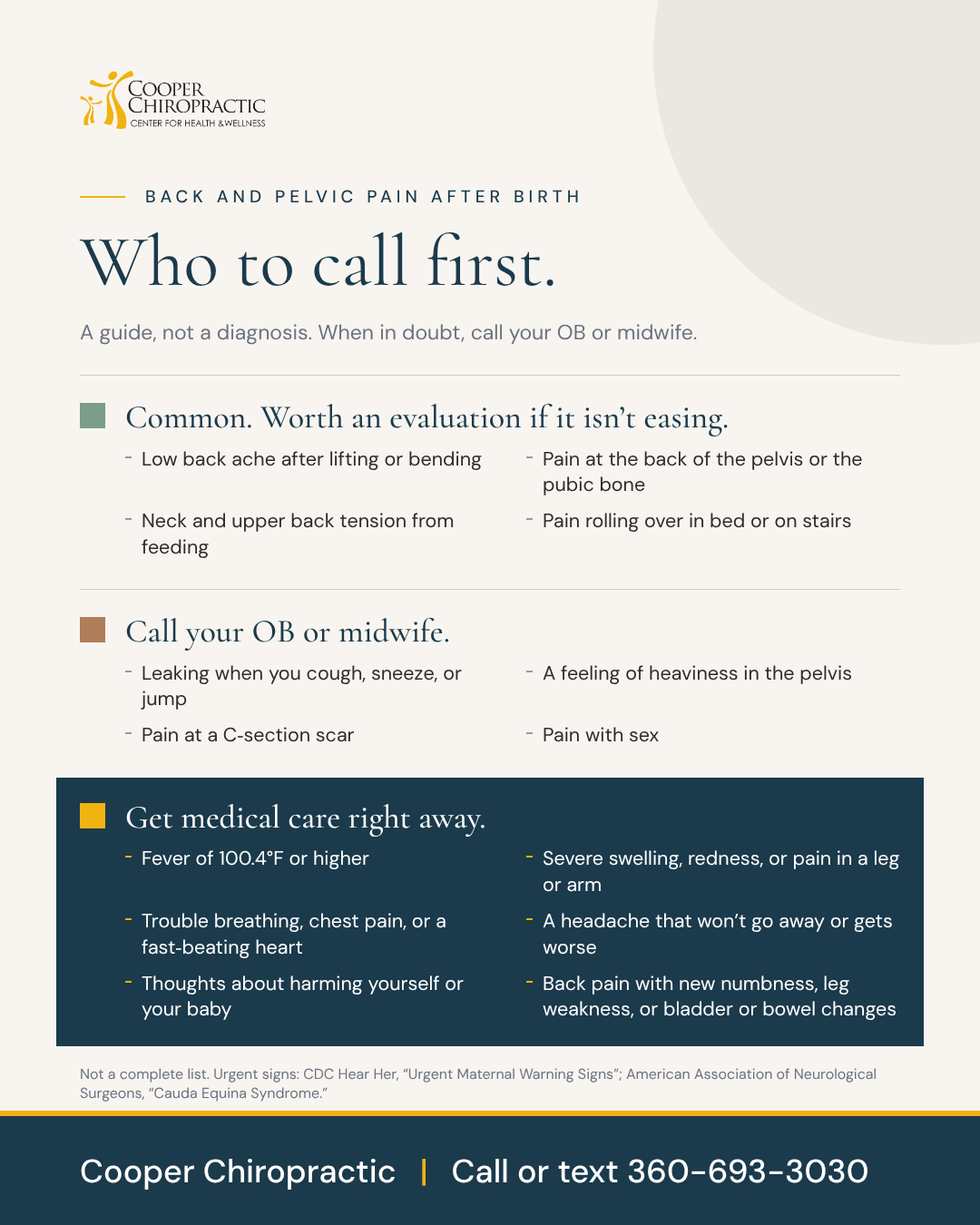
Some symptoms after birth aren’t musculoskeletal, and they shouldn’t wait for a chiropractic appointment.
When to get emergency care, not a chiropractor. The CDC lists urgent warning signs for the year after delivery. Get medical care right away if you have any of these:
- Fever of 100.4°F or higher
- Severe swelling, redness, or pain in your leg or arm
- Trouble breathing, chest pain, or a fast-beating heart
- A headache that won’t go away or gets worse over time
- Thoughts about harming yourself or your baby
If you have back pain together with any of these, go to the emergency room:
- New numbness in your groin, genitals, or buttocks
- New weakness in one or both legs
- New trouble urinating, or loss of bladder or bowel control
Tell them you gave birth within the last year.
Sources: CDC Hear Her, “Urgent Maternal Warning Signs”; American Association of Neurological Surgeons, “Cauda Equina Syndrome.”
A small leak when you cough, sneeze, or jump isn’t the emergency on that list; it’s a pelvic floor question for your OB or midwife.
What the research shows about hands-on care after birth
The research on hands-on care after birth is growing, and that’s encouraging.
A 2025 review looked at 37 randomized trials of women with back and pelvic pain after birth. Spinal manipulation and mobilization, the same kinds of hands-on techniques chiropractors use, reduced both pain and disability in the short term, with moderate-quality evidence. Stabilization exercise, which trains the deep muscles that support your spine and pelvis, had the strongest evidence of anything studied. That’s why a good plan usually includes both.
In a German trial of 80 women whose back pain had lasted at least three months after birth, average pain fell from 7.3 to 2.0 on a 10-point scale after four sessions of osteopathic manipulation, while pain in the untreated group barely changed. And during pregnancy, a randomized trial published in the American Journal of Obstetrics & Gynecology found that adding care from chiropractors (hands-on treatment, exercise, and education) to standard prenatal care reduced pain and disability more than standard prenatal care alone.
What a visit looks like
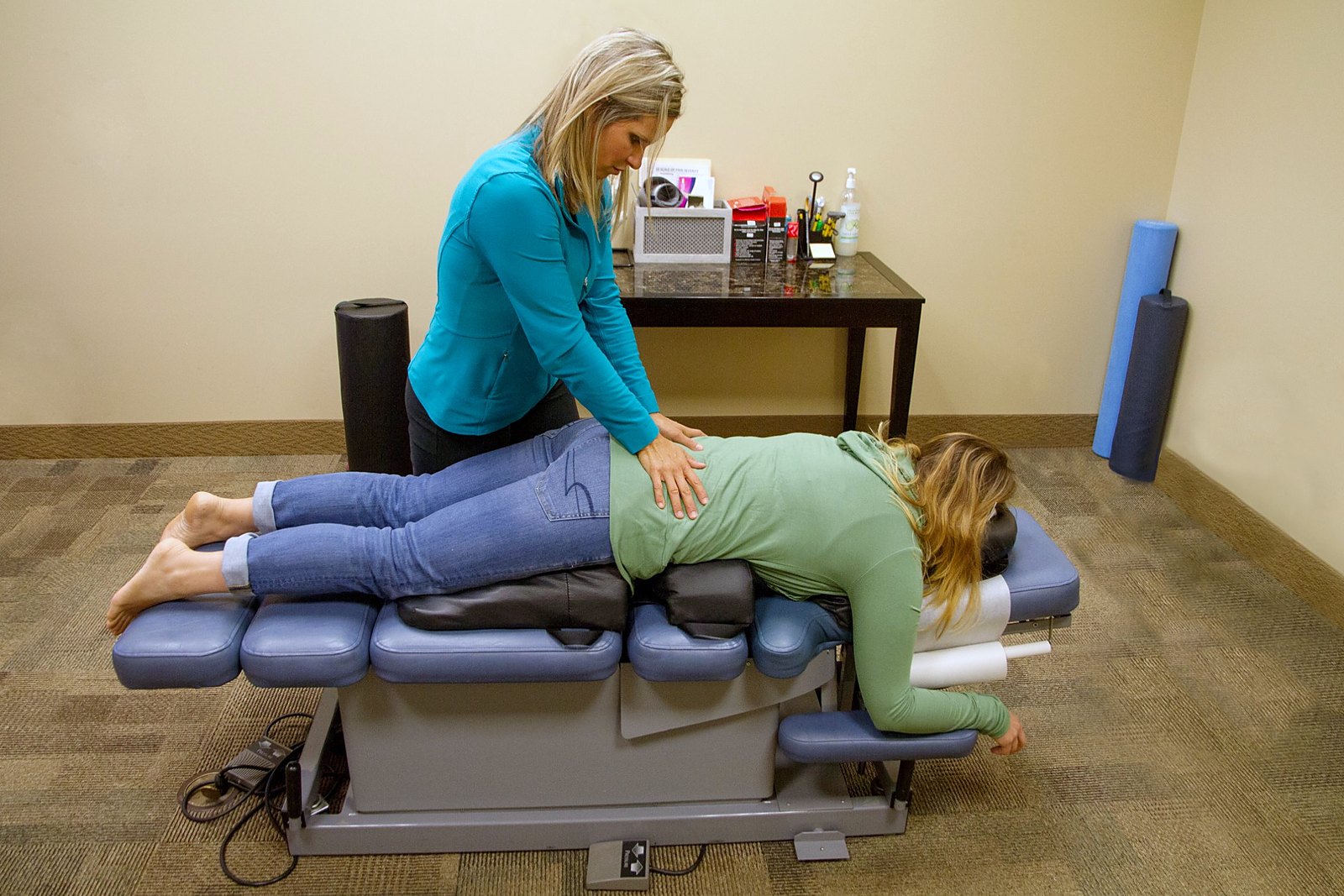
Dr. Karis and Dr. Alyssa start with your history: your pregnancy, your delivery, how you’re feeding, and what you’re lifting all day. They examine your low back, pelvis, and hips, and check for abdominal separation. Then they explain what they found and recommend a plan, which may include adjustments, soft tissue work, and specific exercises. Nothing happens that you haven’t agreed to first.
We also talk about your daily life and activities. Where you feed, how you lift the car seat, and how you get up off the floor all add up across a day and create a repetitive load on your spine and muscles.
If your symptoms point to the pelvic floor, we’ll tell you and refer you to a pelvic floor physical therapist in our community. Pelvic floor therapists train the muscles that support your bladder, bowel, and uterus, and we find co-treatment works wonderfully.
Feeling a little better isn’t the same as fully recovered
According to the same 2025 review, most women recover from pregnancy-related back and pelvic pain within about three months of delivery. But a follow-up study it cites found that roughly 8% to 20% still had pain two to three years later.
Mild pain that’s improving week to week is reasonable to watch. Pain that isn’t improving, or that’s changing how you lift, sleep, or care for your baby, is worth getting evaluated. If it has gone on longer than 12 weeks, our post on what the medical guidelines recommend for chronic low back pain covers the options with the strongest evidence.
Questions about your postpartum recovery? Call or text 360-693-3030.
Common questions
How soon after giving birth can I see a chiropractor?
There’s no single date. We can modify treatment to fit where you are in your recovery, so as soon as you’re ready, we’re ready to see you for an evaluation, gentle treatment, and home care strategies to support your recovery.
Can I exercise with postpartum back pain?
Usually, yes, with the right exercises. In the 2025 review of 37 trials, stabilization exercise had the strongest evidence for reducing postpartum back and pelvic pain. Check with your OB or midwife about timing, especially after a C-section.
Can I bring my baby to my appointment?
Yes. Babies are welcome, and you can stop to feed whenever you need to. Our treatment rooms are comfortable and have space for you, your baby, and the rest of your family.
If it hasn’t eased, that’s the reason to call.
You don’t have to know what’s causing your pain to get it evaluated. We’ll do an evaluation, give you a treatment plan, and create a team approach to your treatment, rehabilitation, and home care.
At Cooper Chiropractic, we’ve cared for Vancouver families since 2006, with a team of chiropractors and a massage therapist under one roof and a 4.9-star average rating on Google. Dr. Karis Cooper and Dr. Alyssa Balducci-Wilson are Webster certified and members of the International Chiropractic Pediatric Association. If you’re still pregnant, visit our post on the Webster Technique, which covers care during pregnancy.
Call or text us at 360-693-3030 to talk through whether care fits your recovery. Or use the Request Appointment form.
About this post: Sources checked October 2026. This is general information, not medical advice, and it can’t tell you what’s causing your pain. Learn more about our prenatal and postpartum care.
About the author: Karis Cooper, DC, co-founded Cooper Chiropractic Center for Health & Wellness in Vancouver, WA, in 2006 with Matthew Cooper, DC.