By Matthew Cooper, DC | Clinically reviewed by Matthew Cooper, DC
You’ve done the ibuprofen. The heating pad. Maybe the imaging, a round of physical therapy, and a stretching routine from a video. Your back still hurts.
By now you’re skeptical of anyone who says they have the answer. That’s healthy.
So we won’t tell you chiropractic is the answer. We’ll show you what a national physicians’ organization recommends for chronic low back pain.
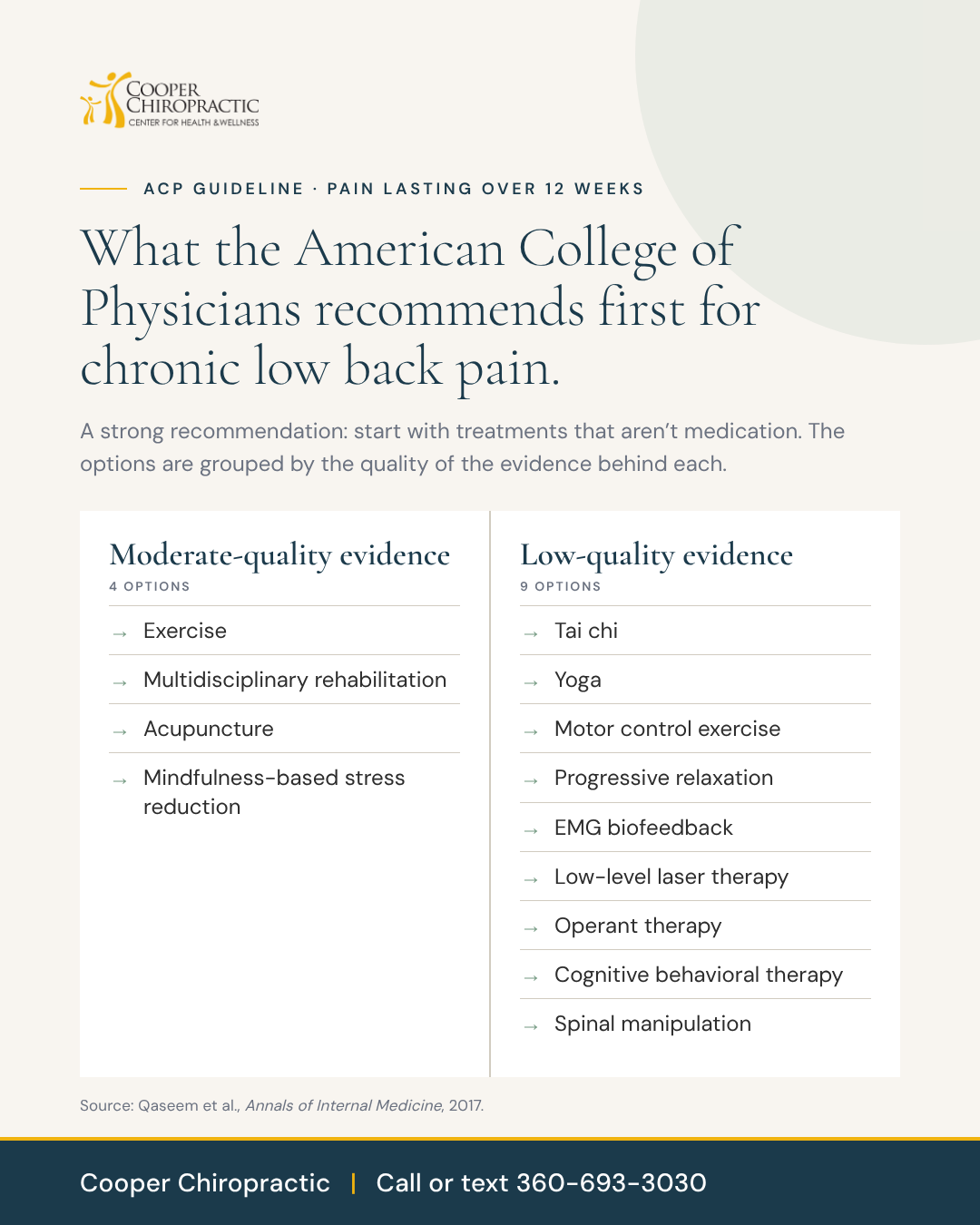
The short answer: For chronic low back pain treatment, the American College of Physicians recommends starting with options that aren’t medication. Exercise, multidisciplinary rehabilitation, acupuncture, and mindfulness-based stress reduction are backed by moderate-quality evidence. Spinal manipulation, yoga, tai chi, and six others are on the same first-line list, backed by low-quality evidence. Medication is a later step, if those don’t help enough.
The chronic low back pain guideline most people have never heard of.
In 2017, the American College of Physicians (ACP), a national organization of internal medicine physicians, published a clinical practice guideline on noninvasive treatment of low back pain (Qaseem et al., Annals of Internal Medicine, 2017).
For chronic low back pain, meaning pain that has lasted longer than 12 weeks, the ACP made a strong recommendation: start with nonpharmacologic treatment. Medication comes later, if those options haven’t worked.
The treatments on that first-line list are exercise, multidisciplinary rehabilitation, acupuncture, mindfulness-based stress reduction, tai chi, yoga, motor control exercise, progressive relaxation, EMG biofeedback, low-level laser therapy, operant therapy, cognitive behavioral therapy, and spinal manipulation.
Read that list again. Most of it isn’t a pill. And most of it asks something of you.
Here’s the part we could leave out, and won’t.
The ACP rated the evidence behind each option. Exercise, multidisciplinary rehabilitation, acupuncture, and mindfulness-based stress reduction were supported by moderate-quality evidence. The other nine, spinal manipulation included, were supported by low-quality evidence. That means researchers are less certain how much they help, not that they were shown to work worse.
We’re telling you this because you’d find it anyway. And because it shapes how we work.
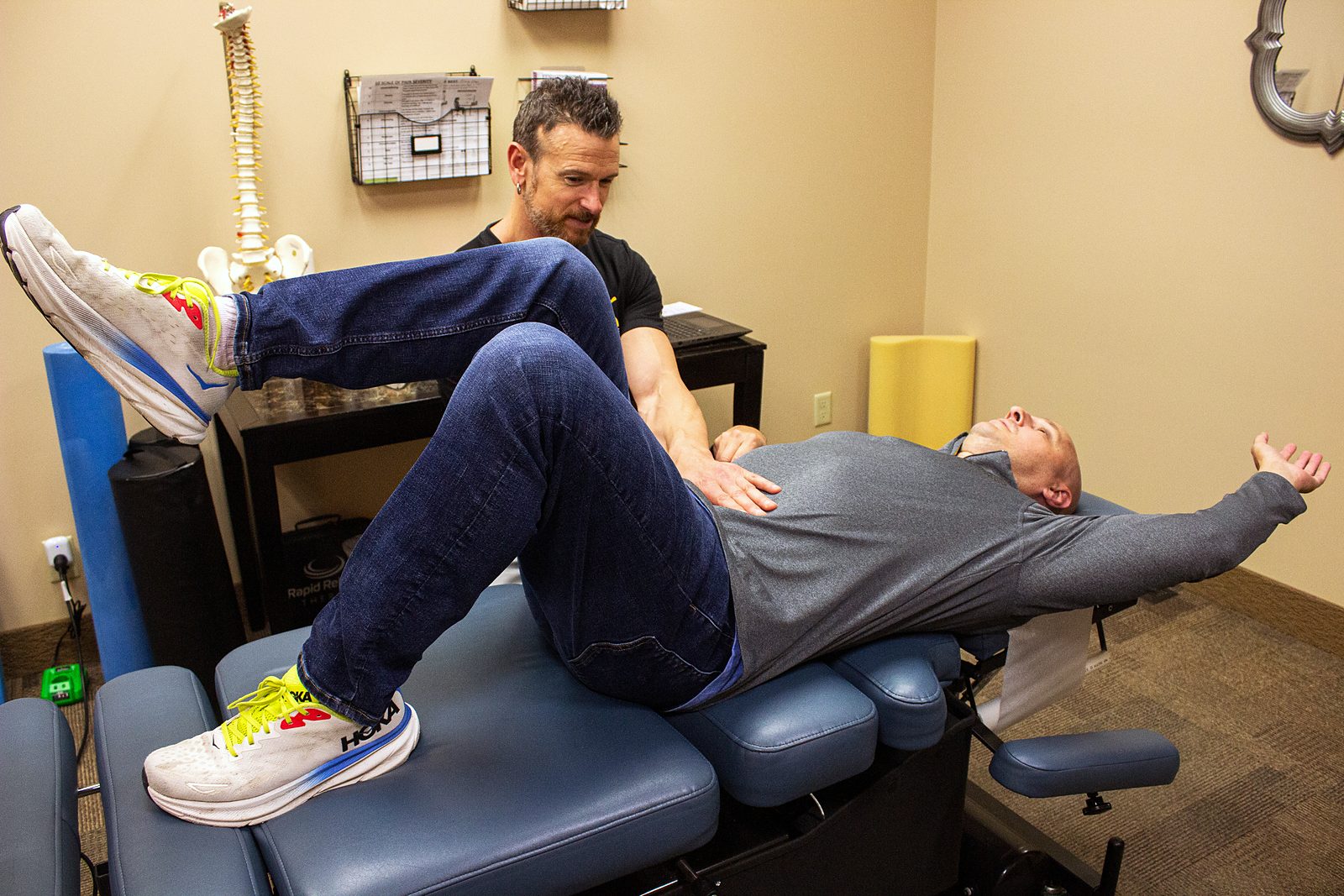
An adjustment, the hands-on spinal manipulation on that list, is one tool. For chronic pain, it’s rarely the only one. That’s why corrective exercise is part of care here, and why we’ll ask you to do some of the work between visits.
That emphasis on exercise isn’t only our view. A 2025 overview of Cochrane reviews, summarized in American Family Physician in February 2026, found that exercise therapy and multidisciplinary programs reduce pain intensity in chronic low back pain compared with no treatment or usual care.
One more honest note. The guideline lists low-level laser therapy. The Class IV laser we use is a different, higher-power device, so that recommendation doesn’t automatically carry over to it. If laser is part of your plan, we’ll explain why, and what we know and don’t know about it.
Chronic pain usually has more than one contributor.
Pain that lasts for months rarely comes from a single source. A joint that doesn’t move well. Muscles that have learned to guard. Movement habits built around avoiding pain. Sleep that never quite restores you.
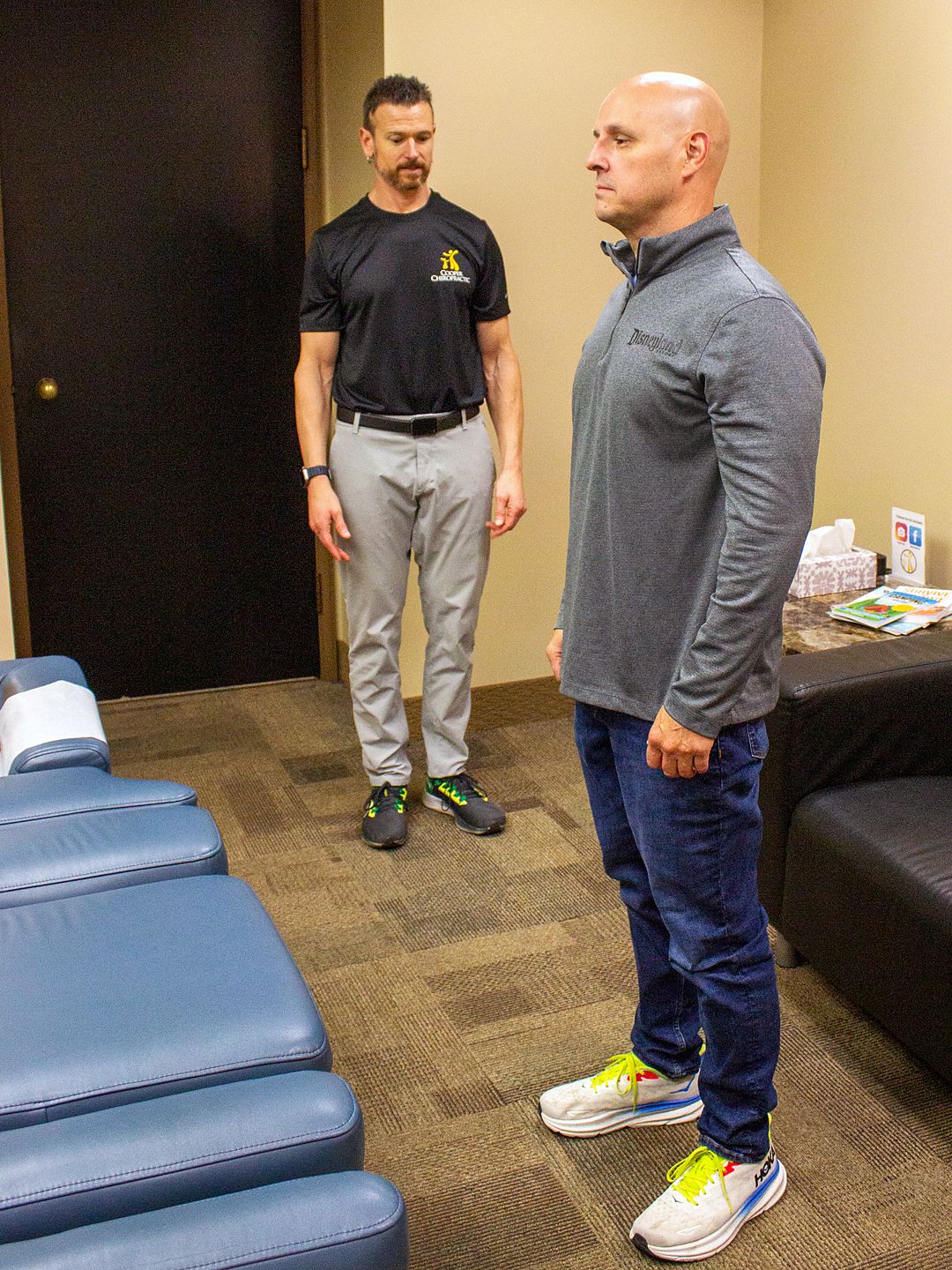
That’s why your first visit starts with a detailed history and a hands-on exam. We look at how you move, sit, sleep, and work, not only where it hurts. Your hips, feet, and posture are part of the picture too.
No two patients receive identical care. Your plan comes from your exam findings.
What you’ll know when you leave.
At the end of your first visit, you’ll know what we found, what we think is driving your pain, and what we’d recommend. If it’s safe and appropriate, treatment usually starts that day.
If your exam points to something chiropractic care shouldn’t treat, or something a different specialist should see first, we’ll tell you and help you find the right care. That’s not a disclaimer. It’s how we practice.
The patients who do best here participate.
You don’t need to arrive with it all figured out. Most people come in hurting, frustrated, or tired of trying. That’s fine.
What matters is willingness. Willingness to do the exercises, change a habit, and ask questions when something doesn’t make sense. We’ll bring the exam, the plan, and the adjustment. You bring the follow-through.
Common questions about chronic low back pain treatment.
How long does back pain have to last to be called chronic?
In the ACP guideline, low back pain is chronic once it has lasted longer than 12 weeks. Pain under 4 weeks is acute, and 4 to 12 weeks is subacute.
Is chiropractic care a recommended treatment for chronic low back pain?
Spinal manipulation, the hands-on technique chiropractors use in an adjustment, is on the ACP’s list of first-line options for chronic low back pain. The evidence behind it was rated low-quality, which is why care here pairs adjustments with corrective exercise instead of relying on them alone.
Should I try medication first?
For chronic low back pain, the ACP recommends the opposite order: start with treatments that aren’t medication, and consider medication if those haven’t worked well enough. Make any medication decision with your physician.
When back pain needs emergency care, not a chiropractor. Get immediate medical attention if back pain comes with any of these:
- Loss of bladder or bowel control, or trouble urinating
- Numbness in the groin, genitals, or buttocks
- New weakness in one or both legs
Source: American Association of Neurological Surgeons, “Cauda Equina Syndrome.”
If you’re tired of guessing, start with an exam.
Cooper Chiropractic has cared for patients with back pain and chronic pain in Vancouver, WA, since 2006, with a team of chiropractors and a massage therapist under one roof and a 4.9-star average rating on Google.
Call or text us at 360-693-3030, or use our Request Appointment form. You’ll leave your first visit with a clear explanation of what we found and an honest recommendation, even if that recommendation is someone else.
About the author: Matthew Cooper, DC, co-founded Cooper Chiropractic Center for Health & Wellness in Vancouver, WA, in 2006 with Karis Cooper, DC.