By Matthew Cooper, DC | Clinically reviewed by Matthew Cooper, DC
It’s 11 p.m., two days after someone rear-ended you at a stoplight. Your neck felt fine at the scene. Now it doesn’t.
You’re searching because you want to know two things. Are you actually hurt? And what happens if you call someone about it?
The second question rarely gets a straight answer. So here it is, step by step, from the moment you walk in.
Not knowing whether you’re hurt is normal.
“I feel fine, so I’m probably fine.” It’s one of the most common things we hear after a collision, and it’s one of the least reliable. Adrenaline suppresses pain. Inflammation in the soft tissue of the neck and back often builds over the next 24 to 72 hours. What you feel right now is not a reliable measure of what happened to your body at the moment of impact.
That’s not unusual. It’s biology.
So the first visit isn’t a commitment to anything. It’s how you find out.
The first thing we do is listen.
Your visit starts with a conversation, not a table. We’ll ask how the collision happened: where you were sitting, whether you saw it coming, which way your head was turned, and what you’ve noticed since. We’ll also ask about things you might not connect to the crash, like trouble sleeping, headaches, or losing your train of thought.
Your nervous system doesn’t sort symptoms into tidy categories. Neither do we.
This part takes time, on purpose. Time is care. The details of how you were hit often explain the symptoms you have now.
Then we examine the structures, not just the sore spot.
Next comes a hands-on exam. We check how far and how comfortably your neck and back move. We test the reflexes, strength, and sensation in your arms and legs. Then we use orthopedic tests to identify which structures are involved: the facet joints, the discs, and the muscles and ligaments that stabilize your spine.
If anything in your history or exam points to an injury that needs imaging or emergency care, we’ll tell you directly and help you get it. That happens. We’d rather send you somewhere else than treat something we shouldn’t.
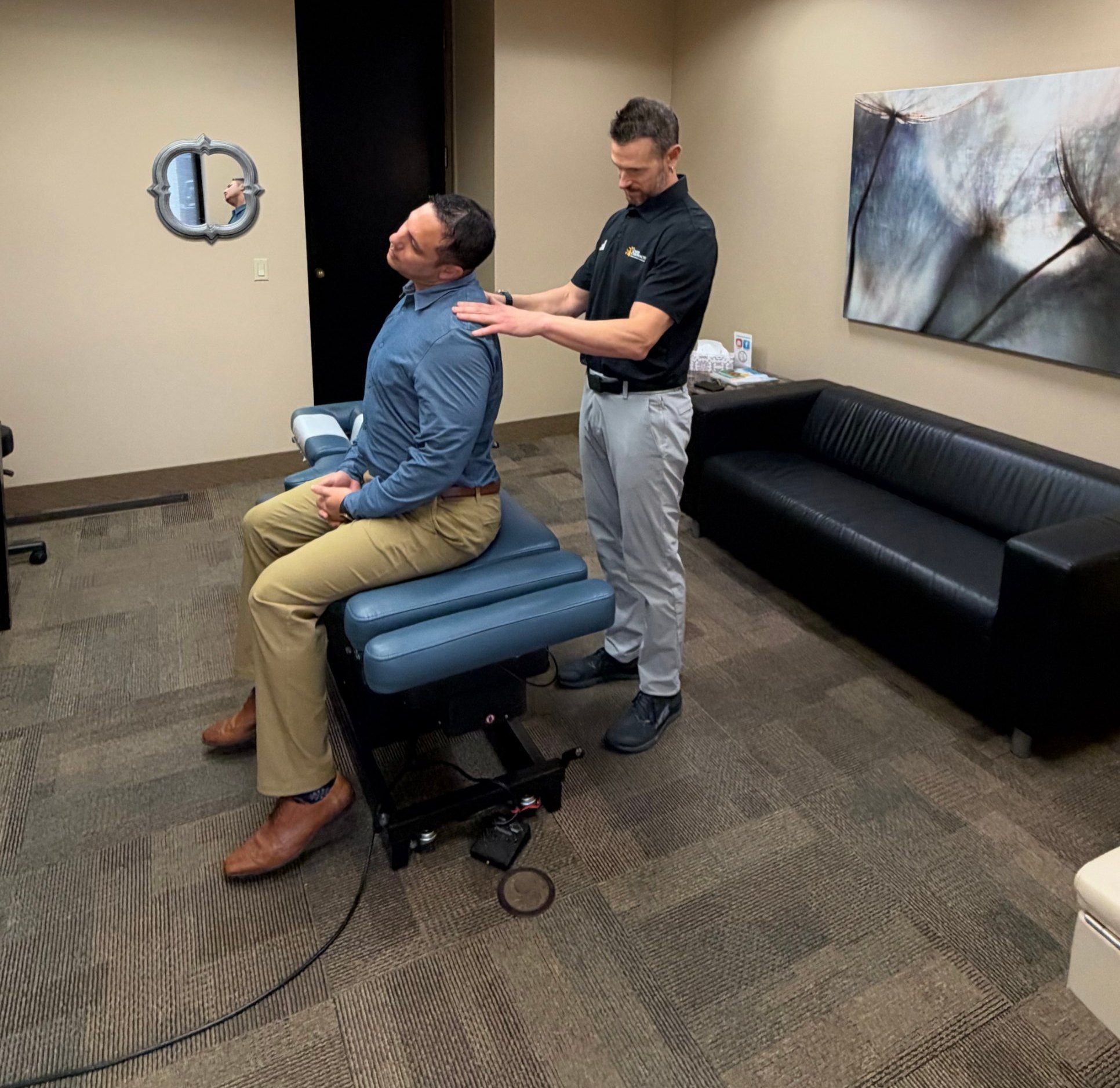
You leave with your findings in writing.
A two-word label tells you very little. Before you go, you’ll have a written summary of what we found: the structures involved, the exam findings that identified them, and what those findings mean for you.
You can read it again at home (most people have questions later, not in the room). You can share it with your primary care provider. And you can ask us about anything that doesn’t make sense.
You also leave knowing what “done” looks like.
At the first visit, we put our discharge criteria in writing. You’ll know what has to be true for us to release you from care before care even begins.
We won’t hand you a number of visits. We can’t honestly predict one on day one, and your body sets the timeline. What we can tell you is how we’ll measure progress and how we’ll decide you’re finished.
One thing to know now: pain is often one of the last things to show up and one of the first to leave. Feeling better is real progress. It isn’t the same as being healed.
Your exam findings set your treatment plan. Nothing else does.

Nothing happens that you haven’t agreed to first.
If your exam shows it’s safe and appropriate, treatment usually starts at the first visit. Before we use any technique, we’ll explain it and show you what it involves.
Nervous about having your neck adjusted after a crash? Say so. That’s a reasonable concern, and we’ll talk it through before anything happens. You decide. We have low-force treatment options for injuries that are more severe.
What about the cost?
In Washington, chiropractic care is covered under personal injury protection (PIP) as a reasonable and necessary medical expense. PIP has no deductible and no copay. You don’t need a referral to see a chiropractor after a car accident, and you have the right to choose your own provider.
Whether PIP is on your specific policy is a question for your auto insurance carrier. We’re used to helping patients ask it.
When to go to the emergency room instead. Call 911 or go to the ER, not a chiropractor, if you have any of these after a collision:
- A headache that gets worse and does not go away
- Weakness, numbness, decreased coordination, convulsions, or seizures
- Repeated vomiting
- Slurred speech, unusual behavior, confusion, restlessness, or agitation
- One pupil larger than the other
- Loss of consciousness, or drowsiness so heavy you can’t be woken
- Loss of bladder or bowel control, or numbness in the groin, genitals, or buttocks
Sources: CDC, “Symptoms of Mild TBI and Concussion“; American Association of Neurological Surgeons, “Cauda Equina Syndrome.”
If you’re wondering whether you’re hurt, that’s the reason to call.
You don’t have to be sure you’re injured to be evaluated. That’s what the evaluation is for.
Cooper Chiropractic has cared for Vancouver patients since 2006, with six providers under one roof and a 4.9-star average rating on Google.
Call or text us at 360-693-3030. We can usually see you today or tomorrow. Prefer to write? Use our Request Appointment form, and we’ll call you back to confirm a time.