By Matthew Cooper, DC | Clinically reviewed by Matthew Cooper, DC
You’ve lived with a sore lower back for years. You know its moods. Stiff in the morning, worse after yard work, better by lunch.
Then someone hit your car. Now it’s different. Sharper, or in new places. Or maybe it’s the same pain, just louder.
People in this spot often talk themselves out of care. “My back was already bad. This is probably more of the same.” It might be. It might not. You can’t tell the difference from the inside.
The short answer: When you have lower back pain after a car accident and your back already hurt before it, care usually happens in order. If your exam finds a new injury, that comes first: settling inflamed tissue and protecting what was injured. Then comes the longer work on the old pattern. Your exam sorts out what’s new from what was already there, and its findings set the pace.

An old problem and a new injury are two different things, even in the same spot.
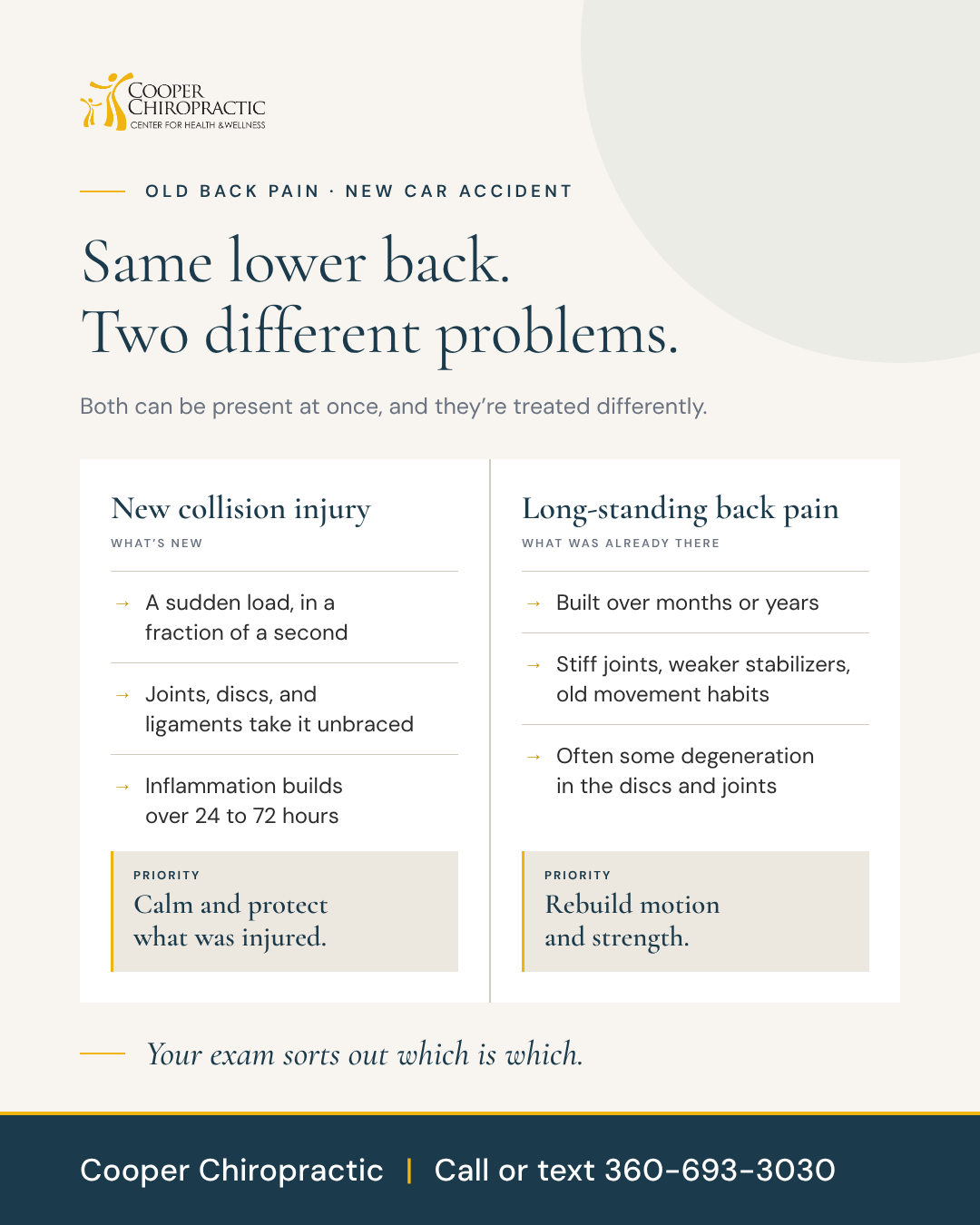
Chronic low back pain usually reflects long-standing patterns: joints that have stiffened, stabilizing muscles that have weakened, and movement habits built around protecting a sore area. Often, the discs and joints show some degeneration, too.
A collision adds something else. In a fraction of a second, the joints, discs, and ligaments of your spine take a load they weren’t braced for. Inflammation in the injured tissue then tends to build over the next 24 to 72 hours.
Both can be present in the same lower back. They behave differently. They’re treated differently.
They tend to follow different courses, too. A 2024 review in the Canadian Medical Association Journal drew on 95 studies of low back pain. On average, newer pain (less than three months old) improved most in the first six weeks, then more slowly. Pain that had already lasted three months to a year improved only a little over the following year, though the evidence there is weaker. The studies looked at back pain in general, not crash injuries specifically.
Care after a crash starts with calming things down.
In the first phase after a collision, the priority is to settle inflamed tissue and protect what was injured, while keeping you moving within comfort. The goal is to let the new injury quiet down without letting you stiffen up.
That usually means care early on looks different from what your chronic back pain would get on its own. Your exam decides how different.
Chronic pain care is about rebuilding what’s been missing.
Long-standing back pain calls for a different kind of work. Restoring motion in stiff joints. Strengthening the muscles that stabilize your spine. Changing the habits that keep aggravating it.
That work depends on you as much as on us. In the American College of Physicians’ 2017 low back pain guideline, exercise is one of the options backed by moderate-quality evidence. A 2025 Cochrane overview, summarized in American Family Physician in February 2026, found that exercise therapy reduces pain intensity compared with no treatment or usual care. It only works if you do it.
When you have both, order matters.
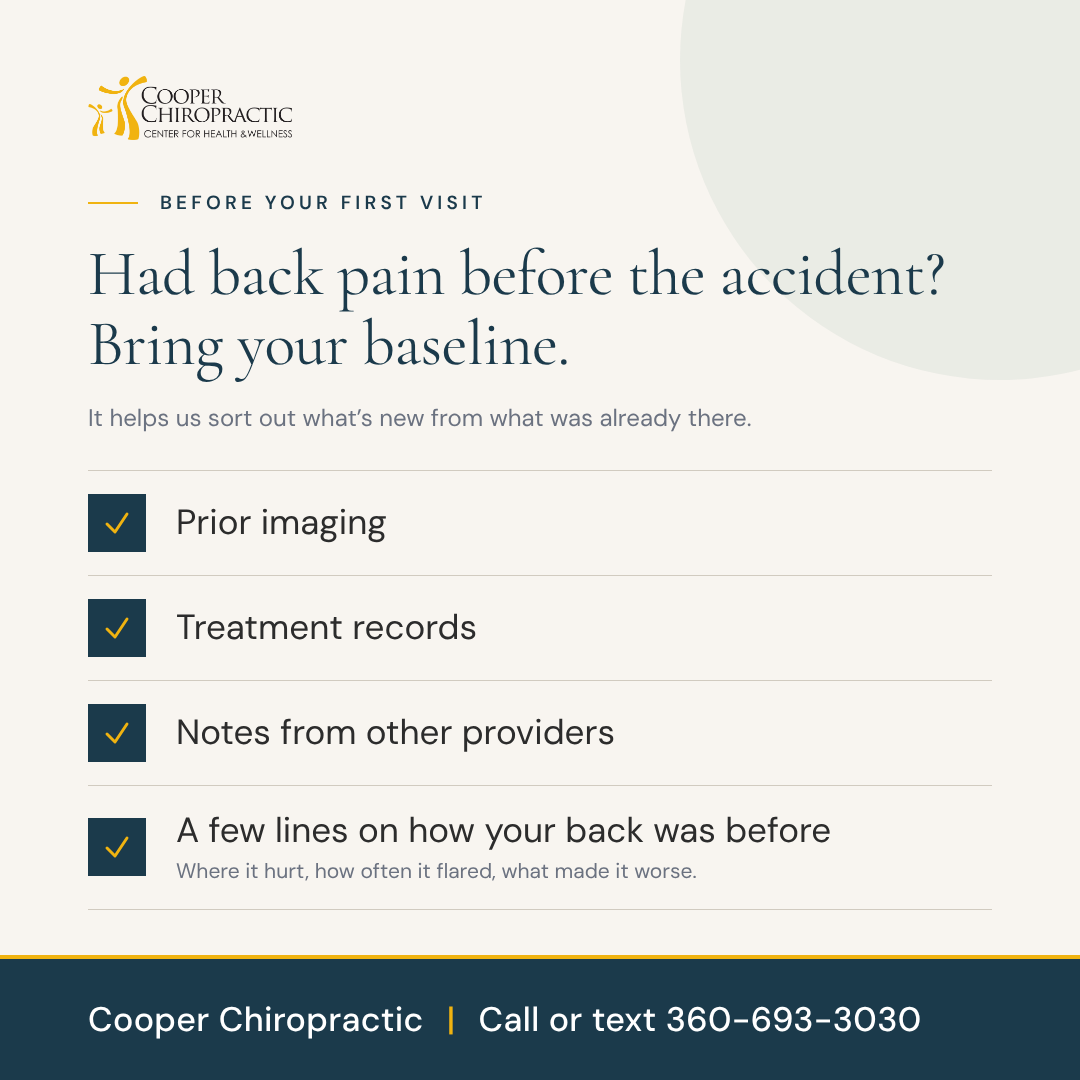
The first job is sorting what’s new from what was already there. Your exam compares what we find now with how you describe your back before the accident: where it hurt, how often it flared, what made it worse.
You can help. If you have prior imaging, treatment records, or notes from another provider, bring them. That’s your baseline, and it makes the comparison sharper.
From there, the plan follows the findings. Usually that means addressing the new injury first, then moving into the longer work on the older pattern once the acute phase settles. Your exam findings set the pace. Nothing else does.
What we won’t do is guess.
We won’t tell you the crash made your back worse before we’ve examined you. We won’t tell you it didn’t, either.
Some people with chronic back pain come through a collision with no new injury at all. Some don’t. The exam is how you find out, and you’ll leave your first visit with our findings in writing.
A note on insurance. In Washington, chiropractic care is covered under personal injury protection (PIP) as a reasonable and necessary medical expense. In general, PIP pays for care related to the accident, and that can include an old problem the crash made worse. Whether it applies to your claim, and to which parts of your care, is a question for your carrier, or your attorney if you have one. Our job is to record accurately what we find.
Feeling better isn’t the finish line.
This matters more when there’s an old problem underneath. Pain is often one of the last things to show up and one of the first to leave. When the new pain fades, it’s tempting to stop. But the new injury may not be finished healing, and the old pattern underneath hasn’t changed.
The authors of the 2024 review suggest that if pain is still recovering slowly six to twelve weeks in, stepping up care then may lower the chance it becomes long-lasting.
We’ll tell you where you actually stand, not just how you feel.
Common questions about lower back pain after a car accident.
How can I tell if the accident injured my back or if it’s my old pain?
You can’t reliably tell from how it feels. An exam compares what we find now with how you describe your back before the accident: where it hurt, how often it flared, and what made it worse. Prior imaging or treatment records make that comparison sharper.
How soon should I be seen for lower back pain after a car accident?
Soon. The earlier the exam, the easier it is to tell new findings apart from old ones. We can usually see accident patients today or tomorrow.
How long until my back feels better?
We won’t guess at your timeline before we’ve examined you. On average, in research that follows people over time, newer back pain improves most in the first six weeks, then more slowly. Pain is often one of the last things to show up and one of the first to leave. Feeling better is real progress, but it isn’t the same as being finished healing.
When back pain needs emergency care, not a chiropractor. Get immediate medical attention if, after a collision, you have any of these:
- Loss of bladder or bowel control, or trouble urinating
- Numbness in the groin, genitals, or buttocks
- New weakness in one or both legs
- A headache that gets worse and does not go away, repeated vomiting, or confusion
Sources: American Association of Neurological Surgeons, “Cauda Equina Syndrome”; CDC, “Symptoms of Mild TBI and Concussion.”
If your back changed after the crash, get it looked at.
If you have lower back pain after a car accident, an early exam tells us what was actually injured, while the new findings are still easiest to tell apart from the old ones.
Cooper Chiropractic has cared for patients with auto accident injuries and back pain in Vancouver, WA, since 2006, with a team of chiropractors and a massage therapist under one roof and a 4.9-star average rating on Google.
Call or text us at 360-693-3030. We can usually see accident patients today or tomorrow. Or use our Request Appointment form, and we’ll call you back to confirm a time.
About the author: Matthew Cooper, DC, co-founded Cooper Chiropractic Center for Health & Wellness in Vancouver, WA, in 2006 with Karis Cooper, DC.